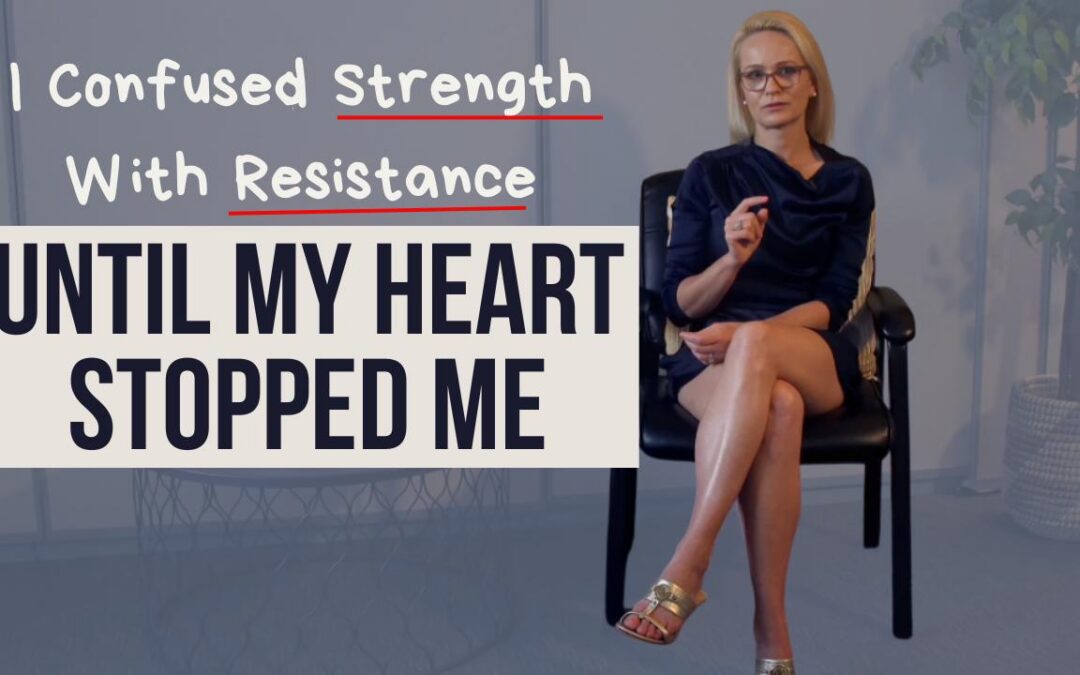
I confused strength with resistance.
My heart changed the way I move.
How an 80% blocked widowmaker changed my relationship with my body, movement, and what strength means to me today.
For most of my life, I knew I was strong. I never questioned that.
I was physically strong.
Mentally determined.
Disciplined.
I trained hard, worked hard, and built my career helping professional athletes recover, move better, and stay available to perform. Strength was part of my identity.
But after learning that my LAD artery — the artery often called the widowmaker — was 80% blocked, I started questioning something I had never questioned before.
Had I confused strength with resistance?
Because I was very good at resistance.
Pushing through.
Holding on.
Working harder.
Training harder.
Staying strong.
Not asking for help.
Not slowing down.
And the more I looked at the relationship I had with myself, the more I began to see the same pattern in the relationship I had with my body.
I wasn't lacking strength. I was lacking balance.
Externally, I was incredibly strong. Internally, I had become incredibly stiff.
And one blocked artery made me rethink the way I moved.
After changing the relationship with my mind, I had to change the relationship with my body
In the last part of my heart journey, I shared something very personal. I had to change the relationship I had with myself.
My thoughts.
My beliefs.
My boundaries.
My voice.
The way I processed pressure.
I realized my artery wasn't the first thing in my life that had felt blocked.
For years, I had resisted the relationship with myself my heart had been asking me to build. A more honest one. A more connected one. A relationship where I could listen without immediately judging myself. Where I could soften without interpreting softness as weakness. Where I could say no without spending the next three days explaining why.
But as someone who has spent decades studying and working with the body, another realization was waiting for me.
I had carried the same mentality into the way I moved.
More resistance.
More strength.
More intensity.
More pushing.
Yes, resistance training has tremendous value. Current cardiovascular science supports resistance exercise as an effective part of cardiovascular health for adults with and without cardiovascular disease.
Resistance training was not my problem. My relationship with resistance was.
I had become selective about the physical qualities I valued. I valued strength. I valued force. I valued discipline. I valued my ability to push through an external load.
But what about flow? What about adaptability? What about elasticity? What about the ability to create tension when I needed it — and release it when I didn't? What about movement quality?
I had spent my career talking about flexibility and fascia. Yet, looking back, I had become incredibly stiff. Not just physically. Internally.
That was difficult to admit.
My heart was blocked. I didn't need more resistance. I needed to rediscover flow.
I want to be very precise here. I am not saying resistance training blocked my artery. It did not.
Coronary artery disease is complex. My family history mattered. My cholesterol metabolism mattered. My nutrition mattered. Stress and lifestyle were an enormous part of my story. And that's the part I feel is fundamental to our healing that healthcare seems not to address as much as we could.
My diagnosis gave me a different lens through which to look at myself.
My heart had a blockage. And everywhere I looked in my life, I saw resistance.
Resistance to slowing down.
Resistance to change.
Resistance to my intuition.
Resistance to difficult emotions.
Resistance to asking questions when something didn't feel right.
Resistance to being misunderstood.
Resistance to letting go.
I had become very good at pushing against life. And suddenly I became curious about flow.
Blood flow.
Movement flow.
Fascial glide.
Breath.
Emotional flow.
The flow of a conversation where I didn't rehearse every word in my head first.
The flow of listening to my body before forcing it to perform.
Maybe I didn't need less strength. Maybe I needed strength that knew how to adapt.
That became the beginning of a completely different relationship with movement.
One artery changed my movement
Movement used to be something I understood intellectually. I knew anatomy. I knew flexibility. I knew fascia. I knew performance. I was one of the early fascia-focused specialists working in professional sports in the United States.
But information and awareness are not the same thing.
I knew bodies. I wasn't listening to mine.
After my diagnosis, movement became a conversation. I stopped asking only: What am I training today? And started asking:
The new questions I move with
- What is my body telling me today?
- How am I breathing?
- Where am I holding tension?
- Am I rushing through this movement?
- Can I feel my feet?
- Can I lengthen without forcing?
- Can I stabilize without stiffening?
- Can I create strength without creating unnecessary resistance?
That is where my movement changed. It became slower at times. More intentional. More three-dimensional.
I started walking on the beach. I breathed. I lengthened my body. I rotated. I paid attention to the relationship between my feet, my hips, my spine, my breath. I focused more on glide. On elasticity. On the quality of everything underneath my skin.
I wasn't exercising less consciously. I was moving more consciously.
Movement stopped being something I did TO my body. It became something I did WITH my body.
The body is listening, even when we aren't
This is where fascia became personal to me in a way it had never been before.
For years, fascia was often described as a wrapping or connective tissue around muscles. Today, not only do I understand that fascia is richly innervated and closely interconnected with the nervous system, but I embody this. Research describes proprioceptive and nociceptive innervation within fascial tissues, while newer work continues to examine fascia's role in sensory processing.
In simple language? The body is constantly gathering information.
When we apply and feel pressure.
When our body is stretched.
When we apply any tension — not just physically, but emotionally as well.
When we move: the tempo, the sequence, the patterns, the angles — it all matters.
When external vibration is applied — and the quality of vibration we generate within us.
Your tissues and sensory receptors are continually contributing information to the nervous system.
I had spent years helping athletes change the information their bodies received through movement and nutrition. Yet I had stopped paying attention to the information coming from mine.
That hit me.
Because movement quality isn't only about perfect technique. Movement quality also requires connection. You have to be present enough to notice. To feel. To adjust. To respond.
And that had to become part of my recovery.
Movement is where my external and internal strength finally met
Today, strength means something different to me. Not less. More complete.
I still believe in building muscle. I still believe in resistance training. I still believe we need physical strength as we age. Of course, we do.
But physical strength without internal adaptability had become incredibly one-sided in my life. I knew I was plenty strong. But I was also stiff.
Could I build a better relationship with my body and everything underneath the skin? That is where internal conditioning and movement finally met for me.
Real strength became the ability to create force without living in force.
To create stability without living in rigidity. To adapt without immediately resisting. To move with awareness. To listen before responding. To flow.
Because a body that only knows how to resist can slowly forget how to flow.
Synergy isn't only something I discovered in my kitchen
In Episode 3 of my heart journey, I shared one of the biggest changes I made to my nutrition. I stopped looking at foods individually. I started looking at relationships between them.
What ingredients together support nitric oxide?
What supports cholesterol metabolism?
What decreases inflammation?
What works together toward the same goal?
I became obsessed with synergy. And then I realized something very important that I hope can help you contemplate the synergies you need in your life.
Why was I applying synergy to my food but not to myself?
My mind and body were not separate projects. My heart wasn't separate from how I carried stress. My movement wasn't separate from my nervous system. My external strength wasn't separate from my internal stiffness.
Strength goes hand in hand with awareness.
Stability with adaptability.
Movement with breath.
Effort with recovery.
Mind with body.
The relationship matters in everything we do.
I guess the question I want you to ask yourself is: maybe the quality of our health is shaped by the synergy between systems we have spent years separating?
That is why Episode 3 became so important to me, and I wanted to bring some awareness not just to those of us who go through a heart-healing journey, but to anyone who wants to improve their relationship with food.
My arteries didn't read the label that said "healthy" or vegan. They responded to the chemistry between the foods I consumed. And my body didn't respond to the identity I had created as "strong." It responded to the way I actually lived — especially internally.
Then, the vibration became part of my silence
There was one more critical shift. More specifically, sound vibration.
For years, I had worked on creating a vibroacoustic portable chair that was not just another tool for high performers on the market, but could serve a bigger purpose in anyone's life — a place for connection in silence.
And during my heart recovery, I began using that vibroacoustic chair differently than initially planned. It became part of my silent internal conditioning time.
I could sit and feel the vibration going from my pelvis throughout my entire spine. I felt parts of my body I had never felt before. I noticed my breath, and I made sure it connected with the vibration. And for once, my mind didn't need to manufacture another task. The vibration gave my body something tangible to feel.
Research on vibroacoustic stimulation has been developing since the 1960s, so I am careful with the claims I make. However, a 2024 study examining vibroacoustic sound massage reported improvements across measures of psychological, physiological, and cognitive stress. This is an emerging field. It is not proof that vibroacoustic therapy or sound vibration treats coronary artery disease. However, I believed I could change my internal vibration and improve the internal environment in which my heart lived.
I never looked at vibration as something that "cleared my artery," yet it became a powerful way for me to connect my mind with my body. It became one of the tools that helped me sit with myself. Connect, listen, and feel.
It helped me access something I had resisted for most of my life.
Stillness.
And perhaps, most importantly, it helped me experience stillness without feeling like I was doing nothing.
What does the quality of our movement tell us?
I used to look at strength as one of the greatest signs of physical capacity. I still value it tremendously. But looking at longevity research has made me think differently about movement.
Walking speed, for example, has repeatedly been associated with survival in older adults. Why might such a simple movement tell us so much?
Because walking isn't one system. It requires strength, balance, and coordination. Also, sensory input and cardiovascular capacity. The body has to integrate multiple systems to create a single, fluid outcome.
That is synergy.
I would never claim that "flow" itself is a clinically validated longevity biomarker. That's not what I am saying. But I now pay close attention to movement quality and flow.
Ask your body
- Can I adapt to any surface?
- Can I lengthen my body with no limitations?
- Can I rotate from both hips and thoracic spine in both directions?
- Can I stabilize on the left side as much as on the right?
- Can I respond to the ground underneath me?
- Can I create tension and then safely let it go?
- How much resistance am I carrying when resistance is no longer required?
Those questions matter differently to me today.
The strongest body isn't the one that resists the most
My heart blockage didn't make me anti-strength. It made me understand strength more completely.
I had spent years training external strength. My heart forced me to develop more of my internal strength.
The strength to listen.
The strength to soften.
The strength to adapt.
The strength to change.
The strength to let go of resistance that was no longer protecting me.
Today, I want a body that communicates. A body that adapts. A body that understands it has options. A body that can generate force and find flow.
I had confused strength with resistance. And I can say that one artery changed that.
Once I changed the relationship with my mind, I knew I had to change the relationship with my body too.
Today, movement is a conversation with my nervous system. And yes — with my heart.
I spent the last decade teaching some of the most talented bodies how to move. And it seems like my heart had to teach me how to listen to mine.
I've created something that helped me begin to reconnect with myself on a level I've always wanted but didn't know how. It's not a meditation. It's not another thing to achieve or check off your calendar. It's a safe space where you can finally connect and hear yourself again — and it's free.
If this can help you find the presence that serves your heart, it would be my honor to be part of your recovery journey.
Listen to the free audio →Take care of your body and heart —
because nobody can do it better than you.